
Description
He sat in the examination hall, staring at the blank answer booklet.
The topic looked familiar, yet his mind felt unfamiliar.
He had read newspapers.
He had underlined editorials.
He had highlighted coaching notes.
But when the pen touched the paper, nothing moved.
His heart raced faster than his thoughts.
He feared the first sentence more than the last question.
He knew the syllabus.
He knew the facts.
But he did not know how to begin.
Every essay he wrote felt scattered.
No structure.
No flow.
No coherence.
Just paragraphs stitched together without direction.
He often ran out of ideas midway.
Sometimes he repeated the same argument in different words.
Sometimes he ended abruptly, unsure how to conclude with impact.
He felt his thoughts were shallow.
He feared the examiner would see through his confusion.
He wondered, “Why can’t I write like toppers?”
He blamed his memory.
He blamed his language.
He blamed his background.
But the real reasons were deeper.
He never learned how to structure ideas logically.
He never practiced multidimensional analysis.
He never saw how philosophy connects to governance.
He never understood how to weave Constitution, ethics, economy, and society into one narrative.
He memorized content, but never mastered articulation.
He thought reading more would solve it.
But reading without framework only created noise.
He needed direction.
He needed models.
He needed clarity.
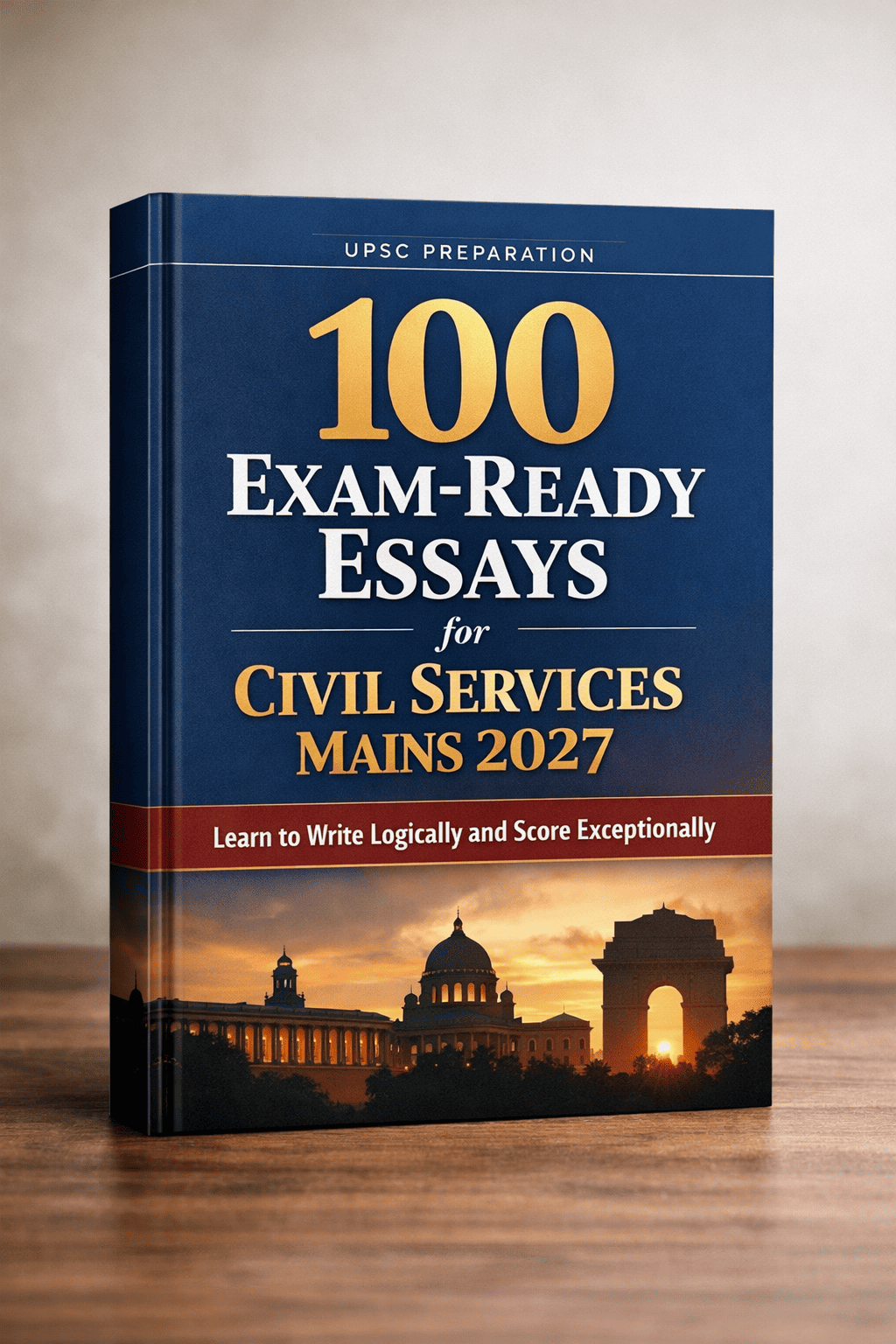
Then he found a collection of 100 well-crafted essays.
Not random essays.
But essays aligned with the evolving pattern of the Civil Services Mains examination.
Each one structured.
Each one layered with dimensions.
Each one flowing from introduction to conclusion with precision.
He studied how introductions were framed.
He observed how arguments were sequenced.
He learned how examples strengthened logic.
He saw how constitutional values were naturally integrated.
He understood how conclusions inspired hope without sounding artificial.
Slowly, his fear reduced.
His blank pages turned into planned outlines.
His scattered thoughts turned into structured arguments.
His weak introductions became powerful openings.
His conclusions began to resonate.
He stopped writing randomly.
He started writing strategically.
He stopped guessing what examiners want.
He started delivering what the examination demands.
He no longer feared philosophical topics.
The difference was not talent.
The difference was exposure to quality models.
The difference was practice guided by clarity.
The difference was those 100 essays shaping his thinking.
And when he walked into the next Mains examination,
He did not stare at the paper.
He smiled at it.
Because this time,
The blank page was no longer his enemy — it was his opportunity.
If you see yourself in this story,
If blank pages still scare you,
If structure feels confusing and conclusions feel forced,
Then you do not lack intelligence — you lack the right blueprint.
Those 100 essays are not just pages.
They are frameworks.
They are patterns.
They are confidence in printed form.
Master them.
Internalize them.
Practice with them.
And watch your Essay paper transform
From your weakest link
To your highest scoring weapon in the Civil Services Mains.
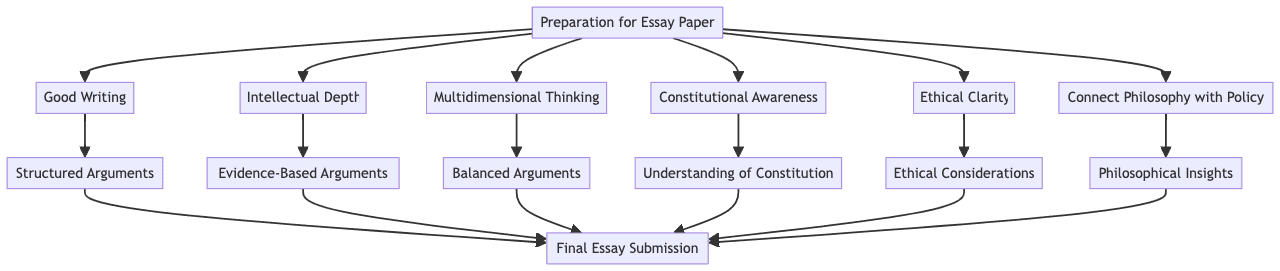
Preparing for the Essay paper in the Civil Services Examination requires far more than good writing—it demands intellectual depth, multidimensional thinking, constitutional awareness, ethical clarity, and the ability to connect philosophy with policy.
This book has been meticulously designed to meet the evolving standards of the UPSC Mains Essay paper, where abstract ideas must be translated into structured, evidence-based, and balanced arguments.
Featuring 100 carefully curated, high-quality essay topics, the book mirrors the contemporary demands of governance, social transformation, technology, environment, economy, and international relations.
I. Philosophical & Ethical Essays
1. Wisdom *****************************.
2. Freedom *****************************
3. Power *****************************
4. Simplicity *****************************
5. Character *****************************
6. Justice delayed is democracy denied.
7. Courage to dissent is the essence of democracy.
8. Compassion*****************************
9. Ethics i*****************************
10. The price of*****************************
11. Happines*****************************
12. Conscience *****************************
13. Means*****************************
14. Truth in times of post-truth politics.
15. Integrity*****************************
II. Essays on Indian Society
1. Social *****************************
2. Gender equality in the 21st century India.
3. Caste*****************************
4. Urbanizatio*****************************
5. Education*****************************
6. Role *****************************
7. Demographic dividend *****************************
8. Poverty *****************************
9. Migration *****************************
10. Role of *****************************
11. Digital*****************************
12. Cooperative federalism in strengthening unity.
13. Regional*****************************
14. Youth *****************************
15. Empowerme*****************************
III. Essays on Governance, Polity & Constitution
1. Constitutional morality in contemporary India.
2. Separation*****************************
3. Electoral*****************************
4. Transpare*****************************
5. Role *****************************
6. Decentr*****************************
7. Civil *****************************
8. Good gove*****************************
9. Public *****************************
10. Federalism under stress.
11. Role *****************************
12. Data *****************************
13. Social media and electoral integrity.
14. Welfare*****************************
15. Policy *****************************
IV. Essays on Economy & Development
1. Inclusive*****************************
2. Atmanirbhar Bharat: Vision and viability.
3. Privatizatio*****************************
4. MSMEs*****************************
5. Role of startups *****************************
6. Agriculture*****************************
7. Universal *****************************
8. Skill*****************************
9. Financial *****************************
10. Globalization in retreat?
11. Sustain*****************************
12. Infrastruc*****************************
13. Digital*****************************
14. Gig *****************************
15. Climate finance and green growth.
V. Essays on Science & Technology
1. Artificial*****************************
2. Biotech*****************************
3. Space t*****************************
4. Cybe*****************************
5. Technology as a tool for social transformation.
6. Digital *****************************
7. Role *****************************
8. Innov*****************************
9. 5G *****************************
10. Data as the new oil: Myth or reality?
VI. Essays on Environment & Sustainability
1. Climate *****************************
2. Environmental*****************************
3. Water crisis in India: Governance or scarcity?
4. Renewa*****************************
5. Urban *****************************
6. Biodiversity conservation and economic growth.
7. Disaster*****************************
8. Sustainable *****************************
9. Role o*****************************
10. Blue *****************************
VII. Essays on International Relations & Security
1. India’s foreign policy in a multipolar world.
2. Neig*****************************
3. Indi*****************************
4. Global governance reforms and India’s role.
5. United Nations*****************************
6. Soft power*****************************
7. Terrorism*****************************
8. Strategic*****************************
9. Energy security and geopolitics.
10. Global *****************************
VIII. Essays on Culture, Values & Civilization
1. Cultural *****************************
2. Indian*****************************
3. Rol*****************************
4. Cinema *****************************
5. Globalization and erosion of cultural values.
6. Secular*****************************
7. Tradition *****************************
8. Language*****************************
9. Spirituality*****************************
10. Vasudhaiva Kutumbakam in contemporary global order.
This is not just a collection of normal essays —it is a structured intellectual resource aimed at transforming aspirants into articulate, balanced, and policy-sensitive thinkers.
Whether you are beginning your preparation or refining your answer-writing strategy, this book provides the conceptual foundation and thematic range necessary to excel in one of the most decisive papers of the Civil Services Mains examination.
| Version | Price |
| Ebook* + Printed Book Delivered at your Address | 1099/- |
| Ebook * Only | 599/- |
Click here to Order (Ebook+Printed Book) = Rs.1099/-
Note: Ebook Validity is 100 Days from the date of purchase.