Description
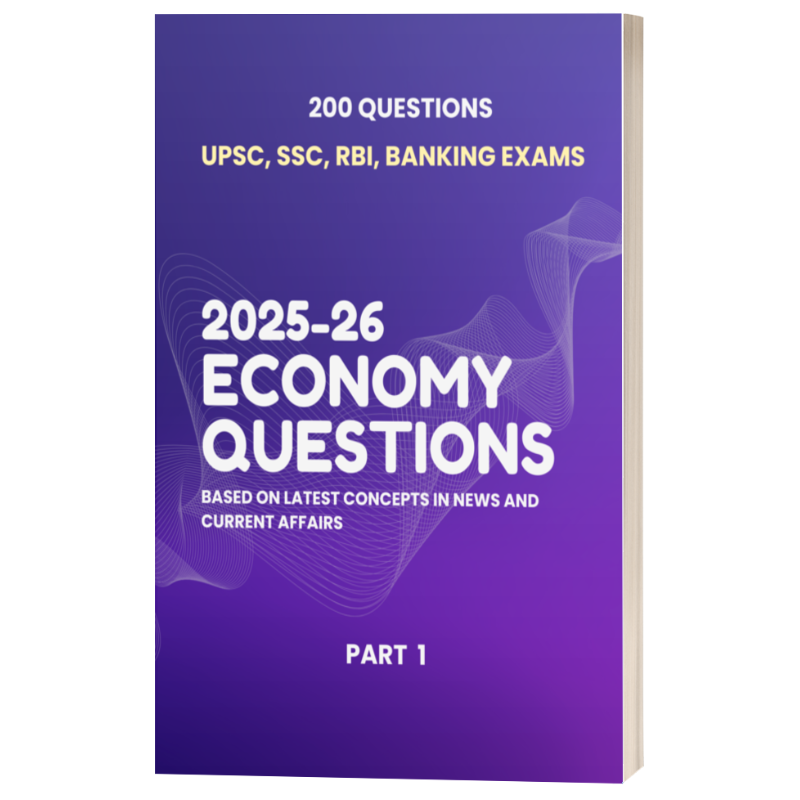
The Economy Questions PDF is a comprehensive collection of 200 carefully designed questions with detailed explanations, created exclusively for aspirants preparing for UPSC, RBI Grade B, SSC, Banking, and other competitive examinations.
Economy questions will be based on the latest and most relevant economic concepts that have been making headlines recently.
What sets this compilation apart is its coverage of both static and dynamic aspects of economics, ensuring that learners develop not only conceptual clarity but also the ability to apply knowledge to current economic developments.
Each question has been framed in line with the evolving trend of competitive exams where traditional textbook learning is no longer sufficient; examiners increasingly focus on applied knowledge, integrating terms and concepts from contemporary global and Indian economic discussions.
Questions on topics like Stagflation, Impossible Trinity, Countercyclical Capital Buffer, Standing Deposit Facility, Quantitative Easing, Greenflation, Gig Economy, and Web 3.0 reflect the depth and relevance of the material.
Alongside these, the PDF also includes fundamental principles such as the Taylor Rule, Ricardian Equivalence, Tragedy of the Commons, and Pareto Efficiency, making it a well-rounded resource.
Explanations provided for each answer are crisp yet comprehensive, allowing aspirants to understand not just the “what” but also the “why” behind each concept. This makes the PDF equally useful for prelims practice, mains answer enrichment, and even interview preparation, where clarity of thought and up-to-date knowledge are indispensable.
For students of SSC and Banking exams, the resource simplifies complex terms into exam-ready insights, boosting confidence in tackling economy-related sections.
If you are truly serious about cracking UPSC, RBI Grade B, SSC, or Banking exams, you simply cannot afford to miss this Economy Questions PDF. Every year, aspirants lose out not because they didn’t study enough, but because they failed to prepare for the kind of advanced, applied economy questions that this PDF covers.
Examiners know that most candidates revise NCERTs and standard books, so they test deeper with conceptual twists and current economy linkages. That’s why these 100 questions, with detailed explanations, are not just practice material but a survival kit.
In short, this PDF acts as both a practice tool and a learning guide, bridging the gap between theory and application, and enabling aspirants to approach the economy segment with confidence, precision, and mastery.
Skipping this PDF means walking into the exam unarmed, risking your attempt, and watching others move ahead. Don’t let that happen—master these questions now or regret later.
WHAT YOU WILL GET ?
In this PDF, you will get 200 high-quality, exam-oriented questions on “ECONOMY” covering the most important economic concepts that are in recent news. Answers and Explanations are also provided in this same PDF. PDF will be sent instantly on your email after successful payment. (No Hardcopy, Only PDF)
DEMO QUESTIONS:
Q1. Consider the following statements regarding the “Impossible Trinity” or Trilemma, a key concept in RBI’s management of external sector:
1. It states that a country cannot have a fixed foreign exchange rate, free capital movement, and an independent monetary policy simultaneously.
2. India has chosen to have a fully floating exchange rate and completely free capital flows, thereby sacrificing its monetary policy autonomy.
3. The RBI often intervenes in the forex market to manage volatility, indicating a managed float regime.
Which of the statements given above is/are correct?
(a) 1 only
(b) 1 and 3 only
(c) 2 and 3 only
(d) 1, 2 and 3
Q2. The “Liquidity Adjustment Facility (LAF)” of the RBI includes which of the following instruments?
1. Repo
2. Reverse Repo
3. Standing Deposit Facility (SDF)
4. Marginal Standing Facility (MSF)
Select the correct answer using the code given below:
(a) 1 and 2 only
(b) 1, 2 and 4 only
(c) 3 and 4 only
(d) 1, 2, 3 and 4
Q3. The “Countercyclical Capital Buffer (CCyB)” is a macroprudential tool that requires banks to:
(a) Hold capital against their cyclical investments in the agriculture sector.
(b) Build up capital during periods of high credit growth to be used during periods of stress.
(c) Maintain a buffer of government securities to counter cyclical liquidity risks.
(d) Create a counter fund to cycle capital from foreign investors to domestic markets.
Q4. The “Volcker Rule”, sometimes mentioned in the context of global banking reforms, is primarily aimed at:
(a) Preventing commercial banks from engaging in proprietary trading.
(b) Capping the CEO’s salary in private banks.
(c) Allowing banks to undertake insurance businesses.
(d) Mandating a higher volume of lending to the volatile energy sector.
Q5. The term “Zombie Lending” or “Zombie Firms”, often discussed in the context of post-pandemic economic recovery, refers to:
1. Companies that are unable to cover their debt servicing costs from current profits over an extended period.
2. Firms that are kept alive only by continuous rollover of loans from banks, often under regulatory forbearance.
3. Non-Banking Financial Companies (NBFCs) that have failed but are yet to be liquidated.
4. Start-ups that have high valuations but no clear path to profitability.
Which of the statements given above are correct?
(a) 1 and 2 only
(b) 2 and 3 only
(c) 1, 2 and 4 only
(d) 1, 2, 3 and 4
Q6. In economics, “Bullwhip Effect” refers to:
(a) The effect of a small change in consumer demand that gets amplified up the supply chain, causing large swings in inventory.
(b) The cracking sound of a bullwhip in the stock market indicating a crash.
(c) The effect of monetary policy on long-term bond yields.
(d) The impact of oil price shocks on inflation.
Q7. The “Beveridge Curve” depicts the relationship between:
(a) Job vacancies and the unemployment rate.
(b) Education levels and income.
(c) Inflation and wages.
(d) Economic growth and poverty.
Q8. The “Global Financial Safety Net” comprises layers of protection for countries facing balance of payments problems. Which of the following are its components?
1. Countries’ own foreign exchange reserves
2. Bilateral swap arrangements between central banks
3. Regional financing arrangements (e.g., Chiang Mai Initiative)
4. IMF financing
Select the correct answer using the code given below:
(a) 1 and 2 only
(b) 2 and 3 only
(c) 1, 2 and 3 only
(d) 1, 2, 3 and 4
Q9. “Petrodollars” are:
(a) Dollars used for trading in pets.
(b) US dollars earned by oil-exporting countries through the sale of petroleum.
(c) A cryptocurrency backed by oil.
(d) Dollars allocated by the US for oil exploration.
Q10. The “Liquidity Trap” is a situation in monetary policy where:
(a) Banks are trapped with too much liquidity and no one to lend to.
(b) People hoard cash because they expect an adverse event like deflation or war, making monetary policy ineffective.
(c) The central bank is trapped by its own policy rules.
(d) The economy is trapped in a cycle of low liquidity.
Q11. “Sovereign Wealth Fund (SWF)” is a state-owned investment fund that invests in:
(a) Only domestic government securities.
(b) Real and financial assets such as stocks, bonds, real estate, etc., globally.
(c) Wealth funds of sovereigns (kings and queens).
(d) Projects that enhance the sovereignty of the nation.
Q12. The “Multiplier Effect” in economics refers to:
(a) The effect of multiple taxes on a single product.
(b) The proportional amount of increase in final income that results from an injection of spending.
(c) The effect of multiple regulators on an industry.
(d) The multiplication of population leading to economic growth.
Q13. The term “Narrow Banking,” often seen in the news, refers to a situation where banks invest predominantly in:
(a) Long-term infrastructure projects
(b) High-risk, high-return corporate bonds
(c) Risk-free assets like government securities
(d) Foreign exchange and derivatives
Q14. The ‘Liquidity Coverage Ratio’ (LCR), mandated by Basel III norms, requires banks to hold high-quality liquid assets to survive a significant stress scenario for a period of:
(a) 7 days
(b) 30 days
(c) 90 days
(d) 1 year
Q15. The ‘Prompt Corrective Action’ (PCA) framework is invoked by the RBI against banks that show weak performance based on parameters like:
(a) Only Capital Adequacy
(b) Capital Adequacy, Asset Quality, and Profitability
(c) Number of branches and customer base
(d) Exposure to priority sector lending
Q16. The term “Sticky Loans,” recently discussed in the context of banking stress, most likely refers to:
(a) Loans with a very low interest rate
(b) Loans that are under moratorium and whose real status is unknown
(c) Gold loans where the collateral is physically stored
(d) Inter-bank loans
Q17. The ‘Base Rate’ system for determining lending rates was replaced by which of the following systems?
(a) Prime Lending Rate (PLR)
(b) Benchmark Prime Lending Rate (BPLR)
(c) Marginal Cost of Funds based Lending Rate (MCLR)
(d) Bank Rate
Q18. The ‘NABARD Sanctioned Special Long-Term Transitional Credit’ is often in the news for providing liquidity to which sector?
(a) Micro, Small, and Medium Enterprises (MSME)
(b) Sugar Industry
(c) Power Sector
(d) Airlines Industry
Q19. The ‘Payment Infrastructure Development Fund’ (PIDF) scheme aims to subsidize the deployment of payment acceptance infrastructure in:
(a) Metropolitan cities only
(b) Tier-1 and Tier-2 centres
(c) Tier-3 to Tier-6 centres and northeastern states
(d) Only in rural areas
Q20. The ‘Leverage Ratio’ for banks, as per Basel III norms, is calculated as:
(a) Tier 1 Capital / Total Assets
(b) Total Liabilities / Tier 1 Capital
(c) Capital / Risk-Weighted Assets
(d) Total Loans / Total Deposits
(These type of 200 Questions with Answers & Explanations will be provided in this PDF)
👉 To get this Economy Questions PDF, simply follow these steps:
Click on “Add to Cart”.
Go to “Checkout”.
Enter your details (name, email, etc.).
Click on “Place Order”.
Make the payment securely.
Once your payment is complete, you will receive instant access to download the PDF and start practicing right away.
For any query: WhatsApp 9463737373 or Call 9463838383 (9am to 9pm).