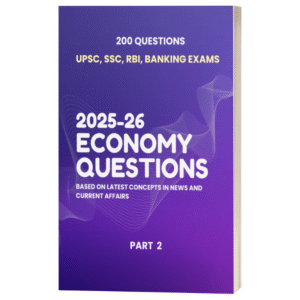

Description
Master the Indian Economy in Just One Book – 100 Core Concepts Simplified!
This Indian Economy is your one-stop solution to conquer the Economy section of UPSC, RBI, SSC, Banking, and State PCS exams. With 257 pages of crystal-clear explanations, it breaks down 100 of the most important and frequently asked economic terms that dominate exam questions and current affairs.
The book spans every vital dimension of economics:
Macroeconomics – GDP, Inflation, Fiscal Deficit, IIP
Monetary Policy – Repo, CRR, SLR, MPC, Inflation Targeting
Fiscal Policy & Budgeting – FRBM Act, Subsidies, Taxation, Budget Deficit
International Economics – BoP, FDI, WTO, IMF, Exchange Rates
Microeconomics – Demand & Supply Laws, Market Structures, Utility Analysis
Development Economics – HDI, Poverty, Gini Coefficient, Sustainable Growth
Banking & Finance – NPAs, Basel Norms, IBC, Mutual Funds, ETFs
Why is this PDF book a must-have?
Because exams today are not asking vague theory—they test concepts in news. From Digital Rupee and Basel III norms to Fiscal Deficit and Inflation Targeting, questions are straight from these chapters. Missing them means losing out on the easiest scoring opportunities.
Whether you’re targeting UPSC Prelims, SSC CGL, or Banking exams, this PDF equips you with the clarity, confidence, and precision to tackle economy questions head-on.
📘 257 Pages | 100 Concepts | Instant Access
👉 Don’t waste time searching multiple sources—everything you need is inside this book.
This Indian Economy book contains 100 Economic Terms/Concepts that are frequently asked in competitive exams, particularly in exams like UPSC, RBI, SSC, and other government and banking exams. [257 Pages]
This book contains following chapters:
Macroeconomics
1. Gross Domestic Product (GDP)
2. Net National Product (NNP)
3. **********
4. **********
5. **********
6. Real GDP vs. Nominal GDP
7. **********
8. **********
9. Deflation
10. Stagflation
11. **********
12. Core Inflation
13. **********
14. Wholesale Price Index (WPI)
15. GDP Deflator
16. **********
17. **********
18. Revenue Deficit
19. Primary Deficit
20. **********
Monetary Policy
21. **********
22. Reverse Repo Rate
23. Cash Reserve Ratio (CRR)
24. Statutory Liquidity Ratio (SLR)
25. **********
26. **********
27. Quantitative Easing
28. Liquidity Adjustment Facility (LAF)
29. **********
30. Money Supply (M1, M2, M3, M4)
31. Inflation Targeting
32. **********
33. Fiscal Policy vs. Monetary Policy
Fiscal Policy and Budgeting
34. Tax-to-GDP Ratio
35. **********
36. Goods and Services Tax (GST)
37. **********
38. Regressive Taxation
39. **********
40. Fiscal Responsibility and Budget Management (FRBM) Act
41. **********
42. Subsidies (Direct vs. Indirect)
43. **********
44. **********
45. Revenue Expenditure vs. Capital Expenditure
46. **********
International Economics
47. Balance of Payments (BoP)
48. **********
49. Capital Account
50. **********
51. Exchange Rate Regimes (Fixed vs. Floating)
52. **********
53. Foreign Portfolio Investment (FPI)
54. Trade Deficit and Trade Surplus
55. **********
56. Tariffs and Quotas
57. **********
58. **********
59. International Monetary Fund (IMF)
60. Special Drawing Rights (SDRs)
Microeconomics
61. Law of Demand
62. **********
63. Price Elasticity of Demand
64. **********
65. Cross Elasticity of Demand
66. **********
67. Monopoly
68. **********
69. Oligopoly
70. **********
71. Diminishing Marginal Utility
72. Indifference Curve
73. **********
74. **********
75. Opportunity Cost
Development Economics
76. **********
77. **********
78. Gini Coefficient
79. Lorenz Curve
80. **********
81. **********
82. Green GDP
83. Kuznets Curve
84. **********
85. Multidimensional Poverty Index (MPI)
Banking and Finance
86. **********
87. Capital Adequacy Ratio (CAR)
88. Basel **********
89. Priority Sector Lending (PSL)
90. **********
91. Shadow Banking
92. **********
93. Digital Banking
94. **********
95. Reverse Mortgage
96. **********
97. Small Finance Banks
98. Derivatives Market (Futures, Options)
99. **********
100. Exchange Traded Funds (ETFs)